Commodity Supplemental Food Program 2026: A Free Monthly Food Box for Seniors 60 and Older
8 min read · Last updated August 23, 2026
- The Commodity Supplemental Food Program (CSFP) gives adults 60 and older a free monthly box of shelf-stable groceries if household income is at or below 150% of the Federal Poverty Level (FPL) – $23,940 a year, or $1,995 a month, for one person in 2026.
- A federal rule effective December 30, 2024 raised that income ceiling from 130% to 150% of the FPL specifically so more seniors would qualify.
- It’s not the Supplemental Nutrition Assistance Program (SNAP): a physical box of food, not a monthly grocery benefit card, and you can receive both programs at the same time.
- Coverage isn’t universal. CSFP operates in parts of all 50 states, the District of Columbia, and Puerto Rico, but a fixed number of caseload slots (731,933 nationally for the 2024 cycle) means coverage and waitlists vary by county.
In this article
- What CSFP actually is
- Who qualifies: age 60+ and the 150% income test
- What’s in the box and how often it arrives
- How to apply through your state agency
- What seniors get wrong about CSFP
- Frequently asked questions
Frances Doyle turned 61 in April, and a caseworker at her county’s Area Agency on Aging mentioned a program she had never heard of: the Commodity Supplemental Food Program (CSFP), a free monthly box of United States Department of Agriculture (USDA) groceries for adults 60 and older whose household income falls at or below 150% of the Federal Poverty Level (FPL). Her Social Security survivor benefit came to $1,640 a month, comfortably under her state’s $1,995 cutoff for a one-person household. Six weeks later she picked up her first box at the same food bank that runs her county’s CSFP site: canned peaches, a jar of peanut butter, dry pasta, powdered milk, and a carton of shelf-stable juice.
What CSFP actually is
CSFP is a federal nutrition program that sends a monthly box of shelf-stable food to low-income adults age 60 and older. It’s administered nationally by the USDA’s Food and Nutrition Administration (FNA) – the agency was called the Food and Nutrition Service (FNS) until it was renamed on June 1, 2026 – which distributes both food and administrative funding to state agencies, U.S. territories, and Indian Tribal Organizations. Those agencies pass the food along to local food banks and nonprofits, which handle applications and hand out the boxes. The USDA’s own program page confirms this structure directly (fna.usda.gov).
CSFP is not the same program as the Senior Farmers’ Market Nutrition Program (SFMNP), which this site has covered separately. SFMNP hands out a small seasonal booklet of coupons, worth $20 to $50 for the year, that only work at farmers markets and only during the summer growing season. CSFP is the opposite shape: a year-round monthly box of canned and packaged staples that arrives every month, not once a season, and isn’t limited to farm-stand produce.
Who qualifies: age 60+ and the 150% income test
You generally qualify for CSFP if you’re at least 60 years old and your household’s gross income is at or below 150% of the Federal Poverty Level. The FPL is the government’s yearly measure of minimum income needed to cover basic costs, and 150% of it is the maximum a state is allowed to set as its CSFP income cutoff.
In real dollars, using the 2026 guidelines for the 48 contiguous states, D.C., and Puerto Rico: a one-person household qualifies at or below $23,940 a year ($1,995 a month), and a two-person household qualifies at or below $32,460 a year ($2,705 a month). Alaska and Hawaii use their own higher figures. This wasn’t always the limit. A federal rule change effective December 30, 2024 raised CSFP’s maximum income ceiling from 130% to 150% of the FPL, and state agencies had until October 31, 2025 to put the higher limit in place – so if you checked your eligibility before that window and didn’t qualify, it’s worth checking again. The USDA publishes the full income table, broken out by household size and state, on its own guidelines page (fna.usda.gov).
Some local agencies also ask whether you’re at “nutritional risk,” a simple determination made by a physician or agency staff rather than a separate application. It’s meant to prioritize the box for people who genuinely need the nutrition it supplies, not to add a hurdle – most applicants clear it without difficulty.
What’s in the box and how often it arrives
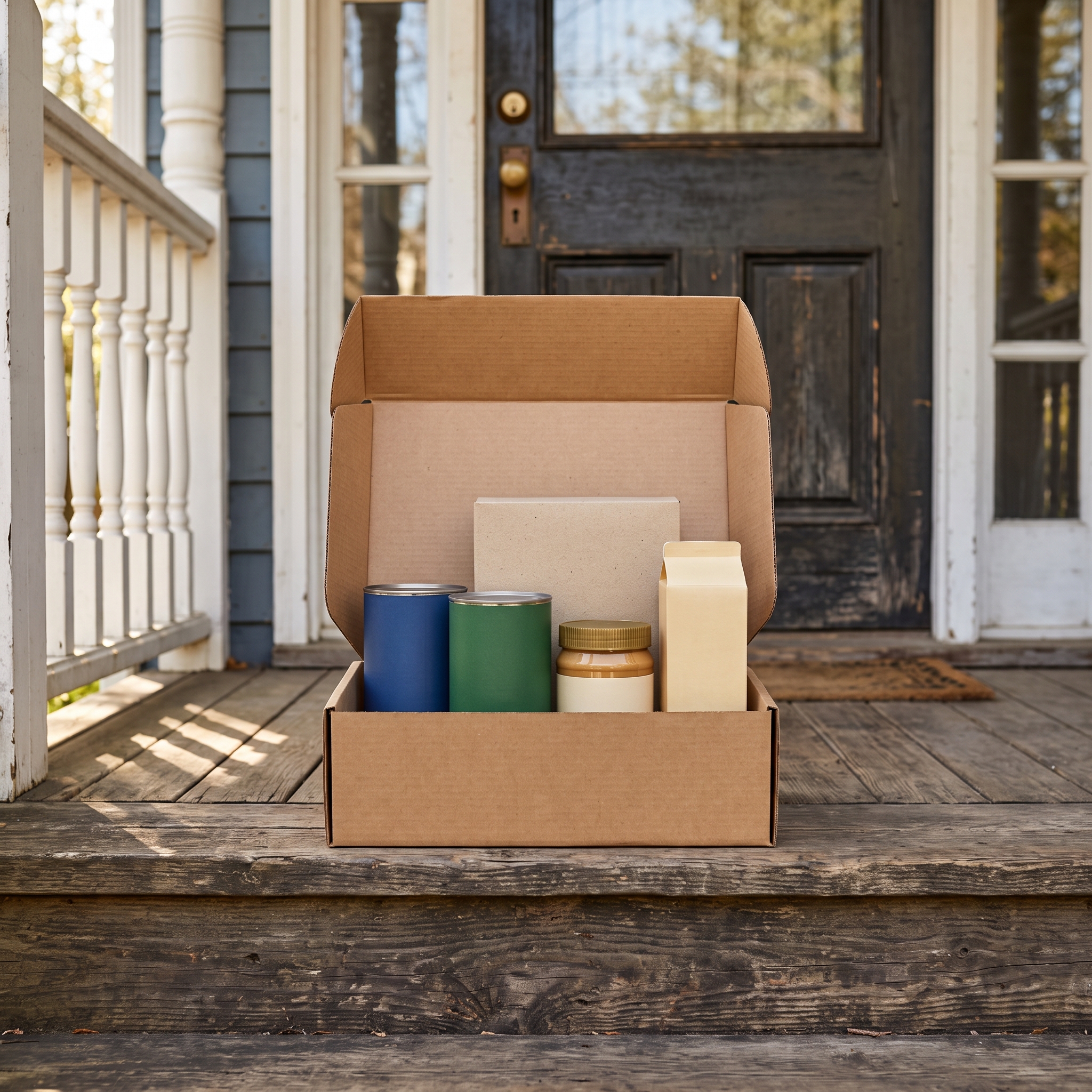
CSFP delivers roughly a 30-pound box of shelf-stable food once a month, every month, for as long as you stay enrolled. The exact contents shift slightly by month and by state, but the food package typically includes canned fruits and vegetables, a shelf-stable juice, a cereal or grain item such as oats, farina, rice, or pasta, peanut butter or dry beans, a canned protein like meat, poultry, or fish, and cheese or powdered milk.
The box isn’t meant to replace a full month of groceries. USDA describes it as supplemental: it’s built to cover nutrients that are commonly missing from the diets of low-income older adults, particularly calcium, iron, and vitamins A and C, not to be a complete diet on its own. Most participants pick their box up in person at a food bank or local agency site each month; some communities deliver directly to participants with limited mobility.
How to apply through your state agency
There’s no national CSFP application or website where you enter your information once and get a decision. You apply through whichever state agency, territory, or tribal organization runs CSFP in your area, and that agency’s local partner determines your eligibility and hands out the box. Start by contacting your state’s CSFP distributing agency or your local Area Agency on Aging, which can tell you which food bank or nonprofit runs the program in your county.
That “in your area” qualifier matters. CSFP operates in parts of all 50 states, the District of Columbia, and Puerto Rico, plus seven tribal organizations, but “parts of” is doing real work in that sentence: not every county in a participating state has a local CSFP site, and USDA’s own guidance tells applicants directly that the program may not be available everywhere within a state. If you’re already piecing together programs to stretch a fixed income, our guide to the Low Income Home Energy Assistance Program for seniors walks through a similarly state-run application for utility costs.
What seniors get wrong about CSFP
The most common mistake is assuming CSFP is just another name for SNAP, or that the two overlap so there’s no point applying for both. They’re structured nothing alike. SNAP is a monthly grocery benefit loaded onto a card that you spend yourself at any authorized store, with no age requirement. CSFP is a specific, pre-assembled box of USDA-selected shelf-stable food, only for people 60 and older, distributed once a month through a local agency. Being enrolled in SNAP doesn’t reduce or block your CSFP eligibility, and the reverse is also true.
The second mistake is assuming CSFP is available wherever you happen to live, with no cap on how many people can enroll. It isn’t an open-ended entitlement like SNAP. CSFP is a discretionary program, funded through annual federal appropriations, and each state agency is allocated a fixed number of caseload slots for the year – 731,933 nationally for the 2024 cycle. Once a local site’s slots are full, new applicants are typically placed on a waiting list rather than turned away permanently, and a spot opens as current participants leave the program. If your county doesn’t have a CSFP site at all, that’s a real gap in coverage, not a sign you did the application wrong.
| Factor | CSFP | SNAP | Senior Farmers’ Market Nutrition Program |
|---|---|---|---|
| What it provides | A pre-packed ~30-lb box of shelf-stable food | A monthly benefit card you spend yourself | Seasonal coupons for fresh produce at farmers markets |
| Frequency | Monthly, year-round | Monthly, year-round | Once per growing season |
| Age requirement | 60 and older only | No age requirement | 60 and older only |
| Income test | At or below 150% of the Federal Poverty Level | Generally at or below 130% gross / 100% net of the Federal Poverty Level | At or below 185% of the Federal Poverty Level |
| How to apply | Through your state’s CSFP distributing agency or local food bank | Through your state’s SNAP agency | Through your state or tribal agency’s SFMNP office |
| Best for | Seniors who want guaranteed shelf-stable staples added on top of other food help | Seniors who want flexibility to choose their own groceries | Seniors who want fresh produce during the local growing season |
Frequently asked questions
Can I get CSFP if I already receive SNAP benefits? Yes. CSFP and SNAP are separate programs with separate applications, and receiving one does not reduce or disqualify you from the other. Many CSFP participants also use SNAP. If you already have SNAP, mention it when you apply for CSFP since some states use it to help confirm your income eligibility faster.
What if my county doesn’t have a CSFP site? Then CSFP genuinely isn’t available to you yet, even though your state participates overall. CSFP operates in only parts of each participating state. Contact your state’s CSFP distributing agency or your local Area Agency on Aging to confirm current coverage, since participating counties can change from year to year.
Do I need to reapply every month to keep getting the box? No. Once your local agency approves you, you typically stay enrolled and pick up a box each month without resubmitting a full application, though most states require a periodic recertification, often once a year, to confirm your income and address haven’t changed.
Will CSFP affect my SNAP, Supplemental Security Income (SSI), or other benefits? No. CSFP food itself is not counted as income for SNAP, SSI, or other federal benefit programs. Receiving a monthly food box does not reduce your SNAP allotment, your SSI payment, or your Medicaid eligibility, so there’s no tradeoff to weigh before you apply.
What happens if I’m told I’m on a waiting list? It means your local site’s funded caseload slots are currently full, not that you were denied. Ask your local agency roughly how long the list typically moves and whether they’ll contact you when a slot opens, and check back periodically since caseload allocations can grow slightly from one year to the next.