
LIHEAP Can Erase a Heating Bill Even When Your Only Income Is SSI
7 min read · Last updated August 18, 2026
- LIHEAP allows states to set an income ceiling as high as 150% of the Federal Poverty Level or 60% of state median income, with a federal floor of 110% of FPL that no state can go below.
- A single senior living on the 2026 SSI check of $994 a month has income equal to just 74.7% of the FPL for one person – below even the strictest floor a state is allowed to set.
- In roughly 20 states and 3 territories, already receiving SSI, SNAP, or TANF makes a household categorically eligible with no separate income test at all.
- Illinois opens LIHEAP applications a full month early, October 1, specifically for adults 60 and older – most states open in November.
In this article
- What LIHEAP actually covers
- Who qualifies, in real dollars
- Why SSI income clears the bar so easily
- How and when to apply
- What seniors get wrong
- Frequently asked questions
Dorothy is 74 and lives alone in Springfield, Illinois on a Supplemental Security Income (SSI) check of $994 a month. In July, her gas company mailed her a shutoff notice over a $340 balance she couldn’t cover. She’d heard of the Low Income Home Energy Assistance Program (LIHEAP) before but assumed her income was too low to bother applying, figuring a program for “low income” households meant something closer to a paycheck than a fixed government check. She had it backward. Her SSI income doesn’t disqualify her from LIHEAP. In most states, it’s exactly the kind of income that gets her in the door fastest.
What LIHEAP actually covers
The Low Income Home Energy Assistance Program (LIHEAP) is a federally funded block grant administered by the U.S. Department of Health and Human Services’ Administration for Children and Families, Office of Community Services. States and territories use it to help households pay heating and cooling bills, respond to energy emergencies like a shutoff, and weatherize homes to cut future energy costs. In fiscal year 2024, the program released $4.1 billion and served 5.9 million households, and 2.5 million of those households included an older adult.
Every state runs its own version of LIHEAP within federal rules, so benefit amounts, application windows, and exact eligibility mechanics differ by state. What’s consistent everywhere is the underlying purpose: LIHEAP is a grant, not a loan, and every state must offer crisis assistance for shutoff notices or exhausted fuel supply through at least March 15 of the heating season.
Who qualifies, in real dollars
Federal law sets the outer boundaries states must work within. States may set their income ceiling as high as 150% of the Federal Poverty Level (FPL) or 60% of the state median income (SMI), whichever is higher, and no state can set its ceiling below 110% of FPL. The Federal Poverty Level is the income threshold the government uses to measure poverty by household size; for 2026, 100% of FPL for a single person is $1,330 a month, so 110% works out to $1,463 a month and 150% works out to $1,995 a month.
That’s a wide enough range that most states’ actual limits fall somewhere in the middle, but the number that matters most for a fixed-income senior is the floor, not the ceiling.
Why SSI income clears the bar so easily
Here’s the math seniors on SSI alone should actually run. The 2026 SSI federal benefit rate is $994 a month for an individual and $1,491 a month for a couple. Compare that against the strictest income limit any state is legally allowed to set, 110% of FPL:
| Household | 2026 SSI income | 110% of FPL (strictest legal floor) | 150% of FPL (highest common ceiling) | SSI as % of FPL |
|---|---|---|---|---|
| Individual | $994/mo | $1,463/mo | $1,995/mo | 74.7% |
| Couple | $1,491/mo | $1,983/mo | $2,705/mo | 82.7% |
An individual living on SSI alone has income equal to 74.7% of the poverty level, well under the strictest limit any state is permitted to impose. That holds true in every state and territory, regardless of which ceiling that state actually chose.
On top of that math, roughly 20 states and 3 territories have adopted “categorical eligibility”: if anyone in the household already receives SSI, SNAP, or Temporary Assistance for Needy Families (TANF), the household is automatically income-eligible for LIHEAP with no separate income documentation required at all. Not every state uses this option, so check with your own state’s LIHEAP office, but if you’re one of the millions of Americans receiving SSI, there’s a real chance your income test is already satisfied before you fill out the form.
How and when to apply
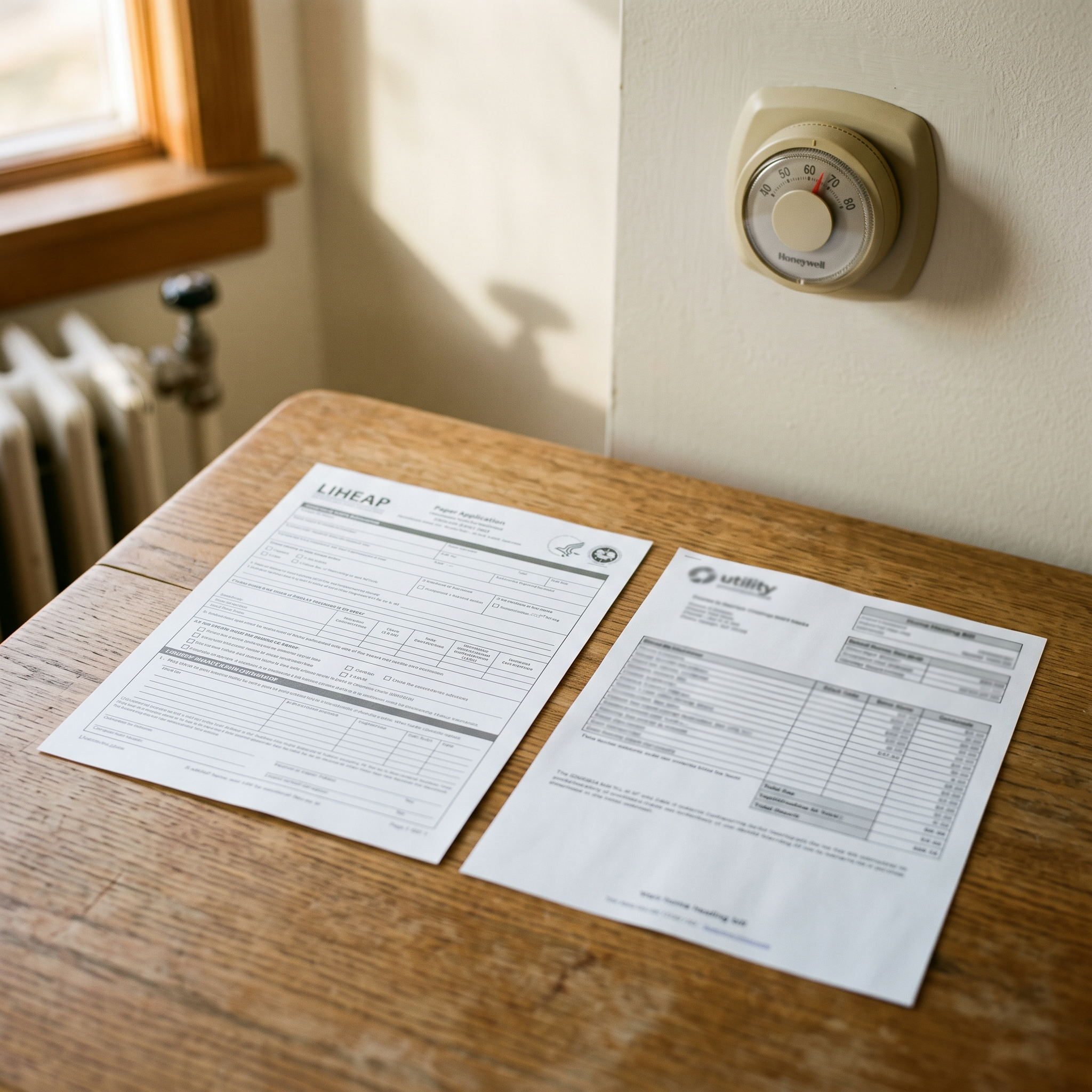
There’s no single national LIHEAP application. You apply through your state, territorial, or tribal LIHEAP agency, or a local Community Action Agency, and most states open their application window in October or November for the winter heating season. A few states build in an early start for older adults specifically: Illinois opens applications on October 1 for people 60 and older, people with disabilities, and households already facing disconnection, a full month before the general public can apply on November 1.
You’ll typically need proof of income from the last 30 days (a Social Security or SSI award letter works), a recent copy of your heating or electric bill, your Social Security number, and proof of TANF or SNAP if you’re using categorical eligibility. Funding is limited and distributed on a rolling basis, so applying as early as your state’s window opens matters. Once a state’s LIHEAP funds for the season run out, no new grants go out until the next funding cycle.
If you’re facing an active shutoff notice or have run out of fuel, ask about crisis assistance specifically. It’s a separate, faster-processed benefit from the standard seasonal grant. Pennsylvania, for example, processes crisis grants within 10 business days, sooner for life-threatening situations, and you can request it even if you already received or were denied a regular grant.
What seniors get wrong
The most common mistake is assuming a LIHEAP approval or denial carries over year to year. It doesn’t. LIHEAP benefits must be applied for every single year, a prior approval doesn’t renew automatically, and a prior denial doesn’t mean you shouldn’t try again, especially if your income or household situation has changed.
The second is not knowing crisis assistance exists as its own track. Seniors who received a regular seasonal grant sometimes assume they’ve used up their help for the year and don’t call back when a shutoff notice arrives months later. Crisis assistance is a different pot of money with its own faster process, and it’s there specifically for exactly that situation.
The same fixed-income math that clears LIHEAP’s income test tends to clear other programs too. If your income comes from Social Security or SSI, it’s worth checking whether you also qualify for a Medicare Savings Program, which can eliminate your Medicare Part B premium using a similar income comparison.
The Weatherization Assistance Program uses a related income test and can fix the underlying heat loss that runs your bill up in the first place, instead of just helping pay it.LIHEAP isn’t the only fixed-income program worth checking. A senior who clears LIHEAP’s income test is also a strong candidate for property tax relief for homeowners 65 and older, which uses a similar income-based approach in several states.
LIHEAP is not the only deduction built around a similar income test. SNAP’s excess medical expense deduction for seniors works the same way, lowering countable income for medical costs over $35 a month, including Medicare premiums.
Some seniors also ask whether a similar program covers water bills. See why the federal water-assistance program built to work alongside LIHEAP currently isn’t accepting new applications, and what to do instead if a water bill is the problem.
Seniors managing a tight budget on heating costs often qualify for more than one seasonal benefit. The Senior Farmers Market Nutrition Program offers a similar once-a-year application for fresh produce coupons.
Frequently asked questions
Does receiving Social Security retirement benefits (not SSI) automatically qualify me for LIHEAP? No. Categorical eligibility in most states is tied to SSI, SNAP, or TANF specifically, not regular Social Security retirement benefits. You can still qualify on income alone. Run your monthly income against your state’s published LIHEAP limit or apply and let the agency calculate it.
What if I applied last year and was denied? Apply again. Eligibility is redetermined every year based on your current income and household size, and funding levels and state rules can change from one year to the next.
Can I get LIHEAP help if I rent instead of own my home? Yes. LIHEAP is based on who pays the home energy bill, not who owns the property, so renters with a utility bill in their name are generally eligible under the same income rules.
How fast does crisis assistance actually help if I have a shutoff notice today? It varies by state, but crisis assistance is built to move faster than a standard application specifically for situations like this. Call your local LIHEAP or Community Action Agency office directly, tell them you have an active shutoff notice, and ask about same-day or expedited crisis processing.