The Equipment Medicare Won’t Pay For, and the State Programs That Loan or Give It Away
7 min read · Last updated September 8, 2026
- All 50 states, Washington D.C., Puerto Rico, and four U.S. territories, 56 programs total, run a federally funded Assistive Technology Act program through the Administration for Community Living.
- In federal fiscal year 2022, state loan libraries lent out 43,347 devices, saving borrowers an estimated $16.76 million compared to buying new.
- The same year, 59,229 people received refurbished equipment through state reuse programs, a combined $38.3 million in savings, and 90% said they could not have afforded the device any other way.
- Medicare Part B generally will not pay for grab bars, ramps, shower chairs, or stairlifts, items state Assistive Technology Act loan and reuse programs stock routinely.
In this article
- What State Assistive Technology Act Programs Actually Do
- Who Qualifies for a State Program
- What It Covers, and Where It Fills the Medicare Gap
- How to Find and Apply to Your State’s Program
- What Seniors and Caregivers Get Wrong
When 78-year-old Arlene Whitfield’s physical therapist recommended a shower chair and a set of grab bars after her hip replacement, her son called Medicare’s help line expecting a straightforward answer about coverage. Instead, he learned that Original Medicare treats both items as convenience equipment, not durable medical equipment, and would not pay a cent toward either one. A county aging office pointed him to his state’s Assistive Technology Act program instead. Three days later a refurbished shower chair arrived at no cost, borrowed from a local loan closet built for exactly this situation.
What State Assistive Technology Act Programs Actually Do
The Assistive Technology Act of 1998, as amended, funds one grant program in every state, the District of Columbia, Puerto Rico, and four U.S. territories. All are administered by the Administration for Community Living (ACL), the agency inside the U.S. Department of Health and Human Services that oversees aging and disability services nationwide.
Each state’s program runs a mix of four core services. Device demonstration lets a specialist show and compare equipment features hands-on. Short-term device loan lets a person borrow a device and test it in their own home before buying anything. Device reutilization, commonly called reuse, gives away or sells refurbished equipment well below retail. Many states also offer alternative financing, a low-interest loan option for larger purchases a loan library or reuse closet cannot cover.
The national coordinating body for these programs is the Assistive Technology Act Technical Assistance and Training Center, known as AT3 Center. It is administered by the Association of Assistive Technology Act Programs and funded through an ACL grant. AT3 Center does not run the state programs directly, it trains them and maintains the searchable directory that connects the public to each one.
Who Qualifies for a State Program
There is no standard national income test. Texas’s Technology Access Program lists its short-term device loans as open to “individuals with disabilities, their families, and qualified professionals,” with a standard 35-day loan period and no income documentation required to borrow. Georgia’s Tools for Life program describes its demonstration and loan services as available to “Georgians of all ages” with a disability-related or aging-related need. Its reuse partnership distributes refurbished durable medical equipment to residents who are uninsured or underinsured at free or reduced cost, again without an income application gate. The pattern holds across the states we checked directly: residency in the state and a disability or aging-related need drive eligibility, not household income. Alternative financing loans are the exception, since those programs typically run a credit check the way any lender would.
What It Covers, and Where It Fills the Medicare Gap
Medicare Part B covers durable medical equipment (DME) when a doctor orders it for use in the home, the item is expected to last at least three years, and it comes from a Medicare-enrolled supplier. Canes, crutches, standard walkers, wheelchairs, hospital beds, oxygen equipment, continuous positive airway pressure (CPAP) machines for sleep apnea, and glucose monitors qualify, and beneficiaries pay 20% coinsurance after meeting the annual Part B deductible.
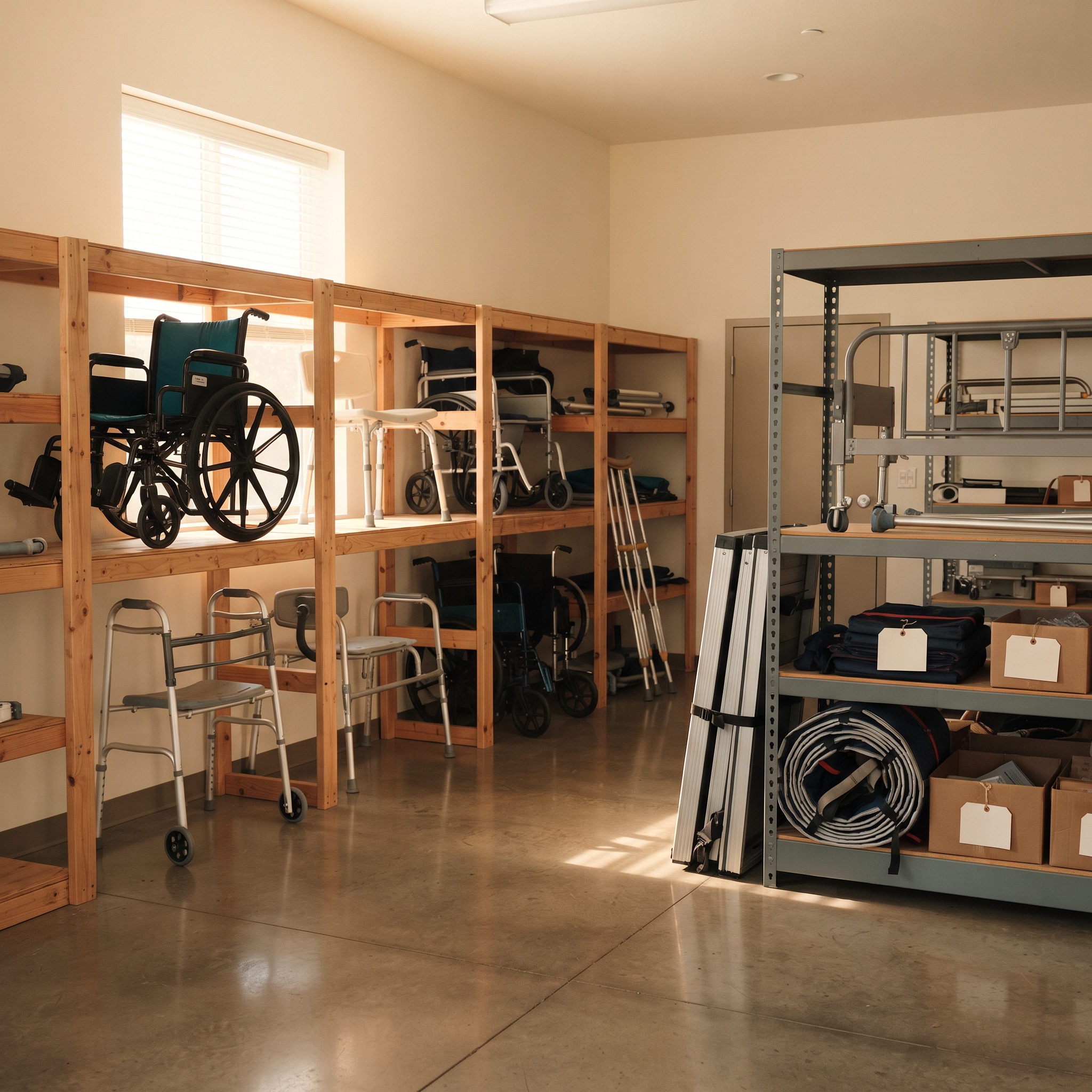
That definition leaves a wide gap. Grab bars, wheelchair ramps, shower chairs and transfer benches, and stairlifts are generally classified as home modifications or comfort items rather than medical equipment, so Original Medicare will not pay for them in most cases. When we checked Medicare’s own coverage lookup tool directly, it had no dedicated covered-item page for grab bars, ramps, shower chairs, or bathroom safety equipment. That absence lines up with how the DME benefit is written. State Assistive Technology Act programs fill exactly that space: loan libraries and reuse closets routinely stock grab bars, shower benches, portable ramps, and patient transfer equipment, alongside the mobility devices Medicare sometimes covers anyway.
| Item | Medicare Part B (DME benefit) | State Assistive Technology Act program |
|---|---|---|
| Hospital bed, wheelchair, walker | Covered with a doctor’s order, 20% coinsurance after the Part B deductible | Loan library lets you try a model first; reuse program offers a refurbished unit as backup or bridge equipment |
| Grab bars | Not covered, treated as a convenience item | Commonly stocked in loan and reuse programs; some states offer financing loans for professional installation |
| Wheelchair ramps | Not covered, treated as a home modification | Portable ramps often available to borrow; alternative financing loans can fund a permanent ramp |
| Shower chairs and transfer benches | Not covered in most cases | One of the most requested items in state loan and reuse inventories |
| Stairlifts | Not covered | Rarely loaned due to installation, but alternative financing programs can help fund the purchase |
Anyone weighing a bigger purchase, like a stairlift or a full bathroom remodel, should also read our guide to home modification grants and loans for aging in place. Some of those programs stack with a state Assistive Technology Act financing loan rather than replacing it.
How to Find and Apply to Your State’s Program
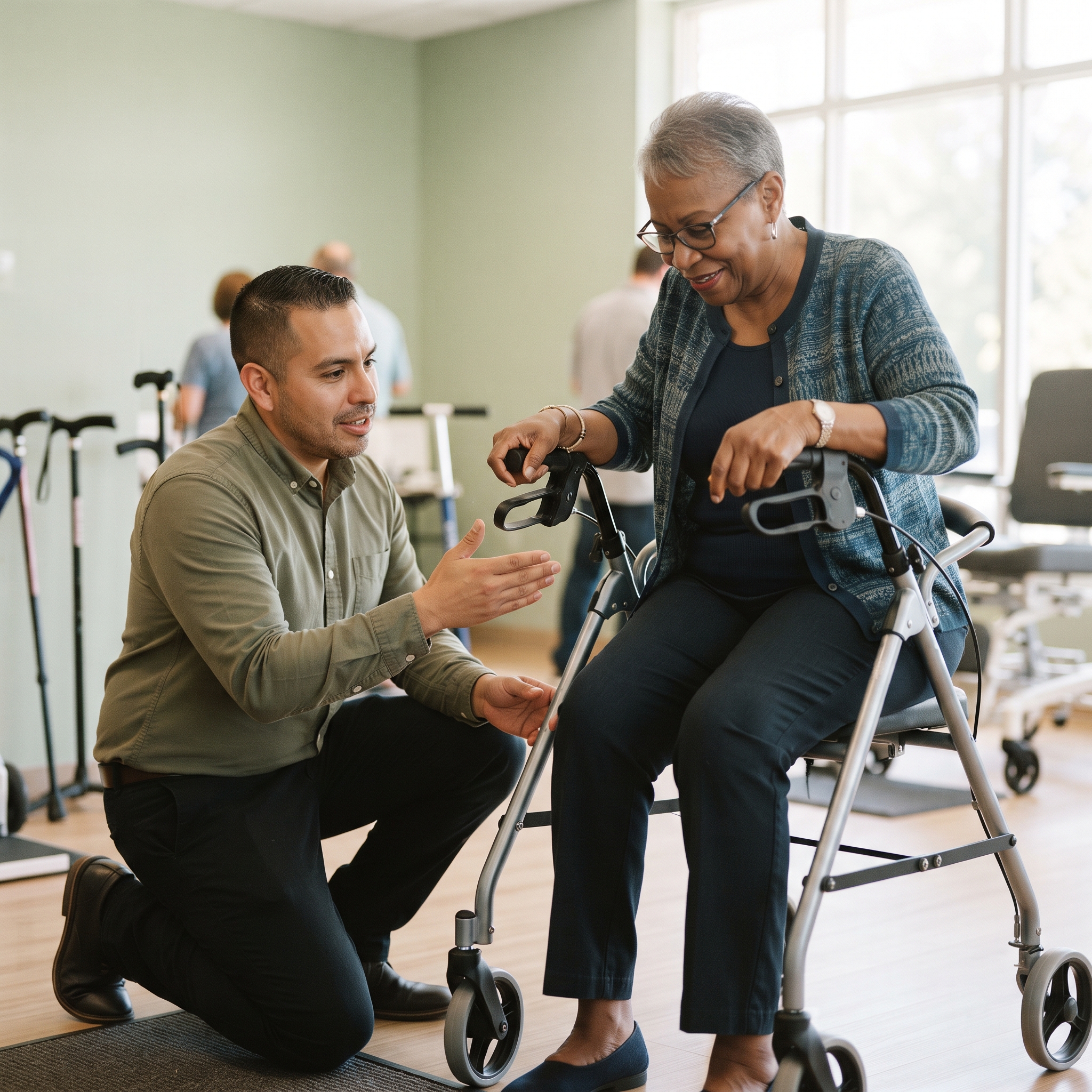
AT3 Center’s state locator lists the official program name, website, and contact information for every state and territory in one searchable directory. The first step is looking up the program by state rather than guessing at a name. Most state programs list their loan library, demonstration center, and reuse inventory directly on their own site, and applying typically means a phone call or a short online form, not a formal Medicare-style claim.
A local Area Agency on Aging can also point families toward the state program alongside other benefits. Our guide to Area Agencies on Aging and the Eldercare Locator walks through how that network operates in every county.
What Seniors and Caregivers Get Wrong
The most common mistake is assuming Medicare will pay for home safety equipment because a doctor recommended it. A doctor’s recommendation supports medical necessity, but it does not change what counts as durable medical equipment under Medicare’s rules. Items like grab bars and ramps fall outside that definition regardless of who suggested them.
According to the Association of Assistive Technology Act Programs’ federal fiscal year 2022 Return on Investment report, state loan libraries lent out 43,347 devices that year, saving borrowers an estimated $16.76 million compared to buying new, while state reuse programs put 88,015 refurbished devices into the hands of 59,229 people, a combined $38.3 million in savings, and 90% of those reuse recipients said they could not have afforded the equipment any other way.
The second mistake is buying equipment outright before testing it. A loan library exists so a family can try a hospital bed, a lift chair, or a communication device in the actual home for days or weeks before spending money on the wrong model. Skipping that step is how expensive equipment ends up unused in a closet.
Frequently asked questions
Does Medicare pay for equipment I borrow or receive through a state Assistive Technology Act program? No. These are two separate systems. Medicare Part B’s durable medical equipment benefit involves a doctor’s order, an enrolled supplier, and coinsurance. A state Assistive Technology Act program loans or gives away equipment directly, often for items Medicare would never cover in the first place.
Is there an income limit to use a state Assistive Technology Act program? Generally no. Programs we checked directly, including Texas’s Technology Access Program and Georgia’s Tools for Life, base eligibility on state residency and a disability or aging-related need, not household income. Alternative financing loans are the exception and typically involve a credit check.
How long can I borrow a device from a loan library? It varies by state and item. Texas’s program sets a standard 35-day loan period for most equipment. Contact your own state’s Assistive Technology Act program directly, since loan lengths and renewal policies differ across the 56 state and territory programs.
Do I need a doctor’s prescription to borrow or receive equipment? Usually not, which is a key difference from Medicare. Most state loan and reuse programs work directly with the individual or family. Some higher-complexity devices may require a professional evaluator to be involved, but a written prescription is not the standard requirement it is for Medicare-covered items.
How do I find my state’s Assistive Technology Act program? Use the AT3 Center’s state locator at www.at3center.net, which lists the official program name, website, and contact details for every state, Washington D.C., Puerto Rico, and the four U.S. territories in one searchable directory. It takes about a minute to find your local office and its phone number.